

Real Violence, Real Emotions: The Genesis of Journey Society
- John E. Carr

- Mar 14
- 6 min read

I rubbed against the metal railing until it shone, trying to focus on the table and not my clothes. “I should have bought a suit,” I thought to myself as I quickly checked one of the IR beacons and rearranged the Oculus Virtual Reality headsets. “You should have packed a suit, dammit.” The thought kept returning, tight and stubborn, as the first wave of art world notables poured into the gallery space. Somewhere to my left a New Yorker magazine photographer lifted a camera toward me. I pretend not to notice, even though my body does. I purposefully look busy reorganizing the already perfectly arranged table and look away.
I dressed for setup, not demo, and definitely not for being seen. I was an engineer, not a museum docent, and yet I was the one posted at the work, the person people turned to for permission and instructions. Two days earlier I had flown in expecting a simple installation, a custom virtual reality system for the Whitney. Instead, technical snags and a shortage of staff pulled me onto the floor for an early preview. So I did both jobs at once, guiding strangers into the piece through Oculus headsets while scanning the system for signs of failure. I tried to look calm, not to look underdressed, and I felt, in every obvious way, out of place.

It is Tuesday, March 14, 2017. It is the Whitney Museum Biennial Preview in New York City.
I am in my mid-thirties. I am at the height of my Hollywood engineering career, a senior technical director at a startup virtual reality and augmented reality entertainment company. Our clients are studios who need custom VFX work, VR setups, programs, and applications. My co-workers are young, brilliant, and highly talented. I make more money than I have ever made in my life. My work is intellectually challenging, yet deeply satisfying. This should be the happiest era of my life, and yet I hear another shutter click and the pit in my stomach grows even more.
I am here delivering a unique project I built, a custom VR system made exclusively for high capacity experiences. The design is brilliant, a self-healing system, resource-balanced with custom programs to revive failing nodes. I should be proud. I should be present to fully experience the moment. But something in me will not line up with the room. I looked around watching various visitors as they chatted, cocktails in hand and eagerly awaiting access to the preview. I should have been excited. I was about to prove that my tech could handle a crowd this size, and yet there is deep sorrow within me. While I tried desperately to keep it private, my grief bubbled to the surface.
About a month ago I lost my mother to cancer.
It was quick, unexpected, and still with me. It kept tugging at my attention, turning down the volume on everything else, so even here, even now, at a career peak, my mind and my heart feel heavy. Worse, it’s in the middle of what is supposed to be a high point, and yet the grief is there. I remember pushing the feeling down, refocusing myself on work. After all, I finally saw my technology being used by the public. As the preview opened, the lines at our table filled quickly, and the feelings of sorrow momentarily faded.
While the tech on the table was mine, the artwork within the headset was exclusively created by the artist, Jordan Wolfson. Wolfson’s VR work was titled Real Violence, and the basic experience was deliberately simple and brutal.
To experience the piece, a user puts on the VR headset and headphones as they hold the railing attached to the table. The piece opens onto a patch of sky framed by buildings on a wide Manhattan street (really Los Angeles), as if you are lying on your back.
“I’m not a bad person. I don’t commit bad acts, and I don’t have bad intentions.” - Jordan Wolfson, Artist
Then the user’s perspective changed. You face a kneeling young man in a red hoodie who looks directly at you. Wolfson, in a gray shirt, steps into the frame and beats him with a baseball bat. He drags him, then keeps going, stomping and kicking. Blood pours and traffic sits on the street like nothing is happening. The viewpoint flips into a dizzying overhead moment, and the audio includes Hebrew Hanukkah blessings. The whole thing is about two minutes and twenty-five seconds.
From the production side, as I remember it, the piece was filmed in Los Angeles and shaped to read New York. The “man” in the red hoodie was a human-sized dummy brought to life by our visual effects artists, with digital work that made violence feel grotesquely real. The program ran as a 360-degree video inside a Unity application. From a technical standpoint, it was an impressive feat of VFX and VR world building. And yet, as people cycle through the piece that evening, the novelty of a VR art experience wears off fast.
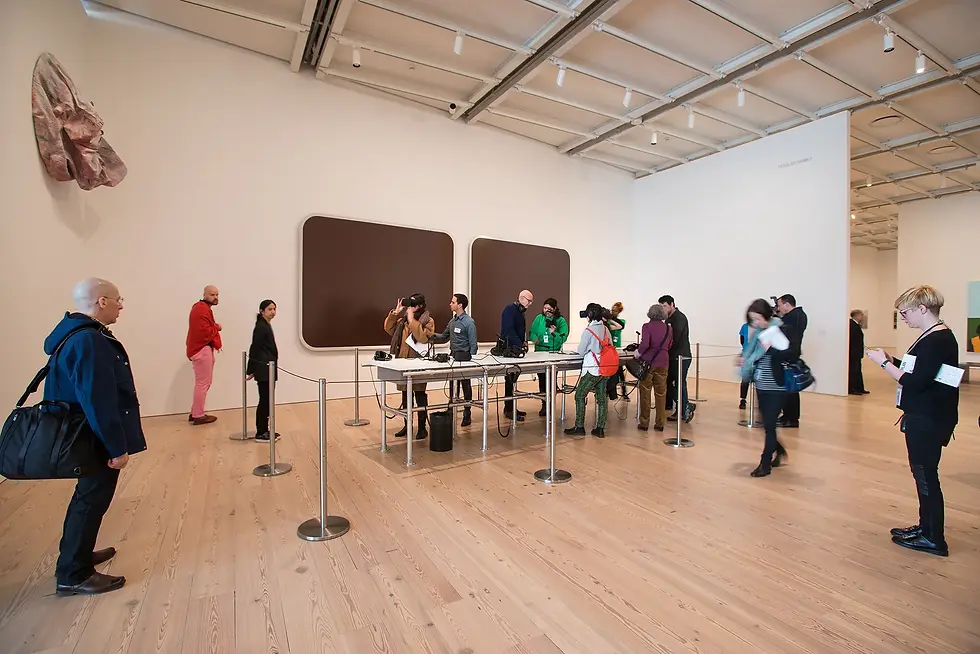
Reactions run across the spectrum from mild amusement to outright rage. Some visitors laughed, others went quiet, and others asked for the headset to be removed immediately. I find myself swinging between pride (“yes, I built this system”) and distance (“I did not create what is inside the headset, I only built the technology it runs on”). I remember one woman looking at me and saying, stern and simple, “maybe you should not have made this.”
The evening goes by quickly. After a few hours I am alone in my hotel room, high on adrenaline from a successful project. I am also processing the mess of emotions the experience has dragged up.
Wolfson’s piece accomplished exactly what art is supposed to do: make you feel and think. While I had no issue with the piece itself, I was quite fascinated by how the combination of art and virtual space could create an immediate and extreme emotional reaction. As an engineer I was no stranger to technology eliciting an emotional response. Who hasn’t had a user frustrated over a technical difficulty or raged against an overly aggressive password policy? But this experience was something more. It was a reaction to both the technology and the world we built into the headset.
Witnessing violence, even artificially crafted, makes you feel and think, and it does it fast. What I could not stop thinking about, though, was the role that the system forced upon people. How quickly did the headset turn a curious visitor into a witness who could not intervene? How quickly did it turn me into someone trying to defend a line between the thing I built and the thing I helped deliver? That night I could feel a question form that had nothing to do with whether the system worked. It worked. The question was what it meant to build something that could hit people like this.
It was also what responsibility followed the engineer when the creation did exactly what it was designed to do.

The next morning the city fell silent. A winter storm pelted New York with inches of snow and shut down the museum and most of the city. Maybe it was the strange purity of fresh snow, the way it covered the grime and softened the edges of everything, or maybe it was grief, how it opened my heart more than I expected, but something in me had changed.

For years my mantra was my generation’s engineering rallying cry: “move fast and break stuff.” But should we move quickly in the digital world we can fully create? This is especially true when those worlds can affect a person’s emotions in powerful ways, or shape what they believe is real. What about AI—the worlds, words, and emotions it can create—how soon before we ask ourselves if we should have built something that could one day affect how humanity understands, questions, and replaces?
The Journey Society project is the fulfillment of those foundational questions I first asked on that day nearly ten years ago. Over time those questions kept following me, and they found a clearer shape through different digital and technical initiatives. These initiatives range from Vancouver’s single occupancy hotels to experimenting with digital spaces and artificial intelligence. Some of the work was connected to classic non-profit systems, including faith-based projects and communities. Some of it was pushed into new territory, where the tools are faster than the frameworks we have for them.
At the core of these experiments is the same set of questions that started at that exhibit table. How can we, as engineers, use these new digital tools to affect the heart in positive and unique ways? How can we build technologies that think, perform, and create on our behalf without giving up responsibility for what they do? What ethics can we bring to artificial intelligence systems, and how can we leverage technology to lift up often underserved communities instead of extracting from them?
The answers are many, but they begin with a journey.


Comments